LARTA’s Guide to Buying Antique Rugs plus decorating tips and choosing the right size rug for a room
Practical advice from the dealers who exhibit at LARTA: what to look for in an antique rug, how to place it in your home, and the terms you’ll hear when you start to buy.
Guide to Buying Antique Rugs
Eight questions to ask before you buy, whether it’s your first rug or a collector’s piece.
Is the age of an antique rug important?
Antique rugs and carpets are ideal for period settings, but can also look spectacular in modern environments. Up to around 1850, all rugs and textiles were produced using natural dyes. These dyes survive the generations well and often result in rich and harmonious colour ranges.
After 1850 chemical dyes began to be employed gradually, and by 1900 many rugs were woven with inferior chemical dyes, which can look either harsh or insipid.
Look for antique rugs with natural dyes.
Does the quality of the weave matter?
It depends on the item. The first point to consider when looking at any antique rug or textile is whether it is beautiful. Is the design well drawn? Does it have balance? Are the colours beautiful? Then you can consider the quality of the weaving.
Is condition important?
Some wear and restoration is acceptable on antique rugs, especially those that have survived from the classical period before 1800. However, the condition of an antique rug is extremely important in determining its value.
Ask the dealer what restoration has been undertaken, in particular whether the ends have been restored, and how much re-weaving has taken place.
What is abrash?
In antique rugs you often find variation in colour known as abrash. This happens when wool of the same colour was dyed in different batches. If the contrast is not too strong, abrash creates an attractive subtlety of colour variation and is highly prized by collectors and decorators.
Where should I buy?
Major auction houses hold occasional specialist sales. However, buying from a good and reputable dealer has advantages: their experience and knowledge are available to you, and most dealers allow clients to view pieces in situ at home, which is a huge benefit.
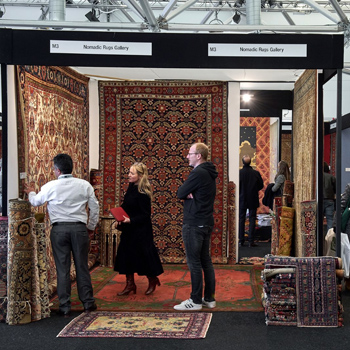
Specialist dealers’ fairs such as LARTA are also an excellent way to compare and contrast a wide choice of similar pieces.
Are antique rugs and textiles a good long-term investment?
First and foremost, buy pieces for their beauty and decorative appeal, and then consider the investment potential. Some groups have proved to be very good investments in recent years, including carpets made before 1800, certain tribal weavings such as Turkoman rugs, and some suzanis. Fine Persian silk rugs have also risen sharply in value.
Discuss the investment potential of any piece with a specialist dealer.
How do I choose the right carpet?
There is a carpet for every setting and every budget. A useful first step is to decide whether you want your choice to make a statement, or to be discreet and understated. That will immediately dictate certain colours and styles, and even the size.
It is generally easier to furnish with repeat designs than with a carpet that has a central medallion. Pale carpets are generally more understated. A dealer will be able to advise you on all of this.
When you’re looking for a rug for a room, bring your room dimensions with you.
Furniture on or off the rug?
Rugs and carpets, whether antique or modern, can transform a room. Dealers are sometimes asked, “Should I put furniture on my valuable antique rug?” Experiment with the placing of furniture to see what creates the best impression. There are, however, some general rules a decorator might suggest: see rug size and placement below.
Choosing the Right Size Rug & Where to Place It
Decorators’ rules of thumb for sitting rooms, dining rooms and bedrooms.
For a sitting room
Three ways to size a rug for your seating area
All legs on the rug
To cover as much floor as possible, choose a rug large enough for all the legs of the sofa and the facing chairs in your main conversation area to sit on it.
For classical proportions in an enclosed room (rather than open-plan), leave about 18 inches (45cm) of bare floor around the rug. In a small room, reduce this to about 8 inches (20cm).
Front legs on the rug
Otherwise, choose a rug size that lets the front legs of the sofa and chairs sit on it, but not the back legs.
No legs on the rug
A small rug should sit in front of the sofa and chairs, either with no legs on it, or with just the front leg or legs of the chairs sitting on it.
In a very large room, consider several rugs, one for each seating area. This works well where two rooms have been turned into one and there is space for more than one seating arrangement.
For a dining room
Room for the chairs to move
- Size: the rug should be large enough that every chair can be moved back from the table without leaving the rug’s edge. Better to have no rug than one your guests snag their chairs on whenever they draw up to the table.
- Shape: match the rug to the table. A rectangular table needs a rectangular rug; a round table, a square or round rug; a square table, a square rug.
For a bedroom
Let the rug frame the bed
- Under the bed: extend the rug 12–18 inches (30–45cm) around the bed: at least 18 inches for a king or queen-size bed, and at least 12 inches for a double or twin. Depending on the size of the room you can go further, but not less, or the rug will look insignificant when it is mostly covered by the bed.
- At the foot of the bed: a smaller rug can be very effective here. It should extend beyond the width of the bed to feel balanced.
- Pairs of rugs often look very good in bedrooms.
It depends on size. Up to 8ft × 5ft (2.40 × 1.50m) is generally called a rug; anything larger is a carpet. In America, all hand-made rugs and carpets are called rugs, and “carpet” means machine-made, wall-to-wall fitted carpet.
Carpet Dealer Terminology
The words you’ll hear on the stands at LARTA, and what they mean.
Kilim
The spelling varies across AsiaA generic term for a flat-woven rug or carpet: one with no pile or nap. Kilims are made in every carpet-weaving country. There are subtle variations in style and technique, but essentially a kilim is made by weaving a weft over a warp for a flat finish.
- IndiaDhurrie
- IranGhelim
- TurkeyKelim
Verneh
Embroidered flat-weaveA flat-weave with embroidery applied on top of the kilim, generally made in the Caucasus region.
Soumak
Caucasus & IranA flat-weave made using a more complex technique than a kilim, which lets the weaver create intricate and refined designs.
General terms for types of rug
- Wool rug
- Silk rug
- Kellei (a long carpet, wider than a runner, up to 6–8ft wide)
- Runner
- Prayer rug
- Nomadic rug
- Village rug
- City rug
- Court rug
The Four Main Categories of Rug
Carpet and rug weaving falls into four broad categories.
Court weaving
Royal workshops, usually before 1800Carpets and textiles made for rulers in the East in their own court workshops, to a very high standard. More often than not, artists were involved in creating the designs alongside master weavers and dyers. Many great examples survive in private and public collections.
Among the earliest known pieces are the great Seljuk carpets from Anatolia, dating to the 11th and 12th centuries; today these masterpieces of woven art are found only in Turkish museums. Later court carpets from the Ottoman period in Turkey have survived in large numbers and often appear on the market. In Persia, carpets made before 1850 are extremely rare, but Safavid court carpets from the 16th to 18th centuries can be seen in collections, and some are considered among the greatest carpets ever made. Great carpets and textiles were also woven in the courts of India during the Mughal period, and there were famous Imperial workshops in China.
Court weaving was not limited to Eastern cultures. In France, Louis XIV had the Gobelins workshops weaving rugs and tapestries. In Russia there were royal workshops in St Petersburg making for the Tsars, and Russian aristocrats and monasteries also had workshops on their own estates.
City rugs & carpets
Organised urban workshopsRugs and carpets woven in organised urban workshops under controlled conditions: weavers follow patterns, while supervisors ensure high quality. These rugs are generally well produced, with formal designs drawn as cartoons before weaving.
Some great weavers in Persia and elsewhere are associated with the finest workshop rugs of the 19th century, including the Persian master weavers Mohtasham in Kashan and Haji Jalili in Tabriz. In the 20th century, the master weaver Amoghli of Mashhad was known for woven masterpieces, and the Seirafian family of Isfahan have produced high-quality rugs for generations.
Village rugs
Woven by families in rural settingsRugs woven by individuals and their families in rural settings, with or without finance from an entrepreneur, made for both domestic and commercial use. The weaver usually follows their own pattern traditions, which may have been passed down through generations.
Village rugs are very often charming and can reveal the weaver’s own ideas: their interpretation of designs or of individual ornaments. Many wonderful examples have survived from Turkey, Persia and elsewhere.
Tribal or nomadic
Woven on the moveNomadic life was a fundamental part of Eastern civilisation for millennia. Tribal groups migrated with their animals and belongings between winter and summer quarters, often in the harshest conditions. Weaving was central to their material culture: covers, saddle bags, and rugs for the floors and walls of their tents, as well as pieces woven to sell or barter at market.
The designs on tribal weavings often convey early spiritual beliefs, or are decorated with charming depictions of nomadic life: animals, trees, plants and flowers. Today the best weavings of several tribal groups are highly collectible.
See it for yourself at LARTA
Compare hundreds of antique rugs, carpets and textiles at every price level, and talk to the specialist dealers in person.